RAM or Random Access Memory can be defined as short-term memory, which the computer can make use of to store temporary information, required to quickly open apps, desktop programs and files.
The amount of RAM available on a computer determines its overall speed and capacity to handle multiple apps and desktop programs running on the computer.
If a computer is lacking in RAM capacity, it ends up storing and retrieving data from its allocated virtual memory location (C:/pagefile.sys) on the Hard Disk, which slows it down.
Check RAM SIZE & Speed In Windows 11/10
If you are looking for a way to check the size, type and speed of RAM installed on your computer, it is likely that you are thinking in terms of increasing the amount of RAM installed on your computer.
Hence, we are providing below 3 different methods to check information about the type, size and speed of the RAM installed on a Windows computer.
1. Check RAM Size Using Settings
You can follow the steps below to check the size of RAM installed on a Windows computer.
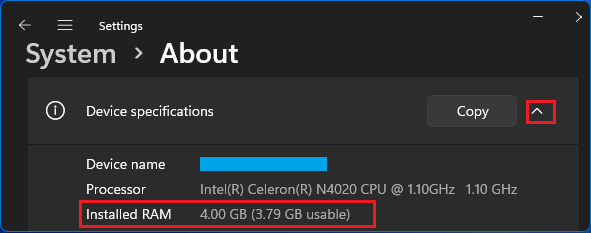
Go to Settings > System > About > On the About screen, you will be able to see the Size of RAM installed on the computer under “Device Specifications” section.
Windows 10: Go to Settings > System > About > In the right-pane, you will see the Size and Speed of RAM installed on your computer under “Device Specifications” section.
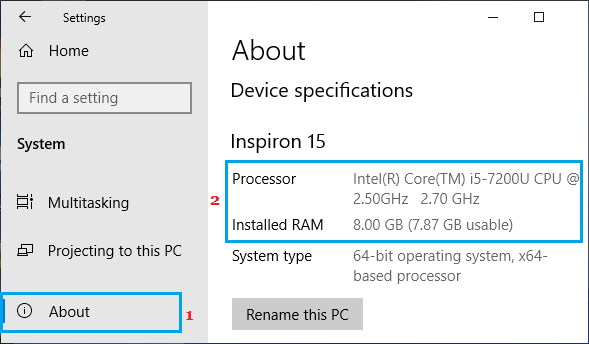
Note: The actual usable RAM is always a bit less than Installed RAM.
2. Check RAM Size Using System Information Tool
You can check the amount or size of RAM installed on a Windows computer by using the built-in Microsoft System Information tool.
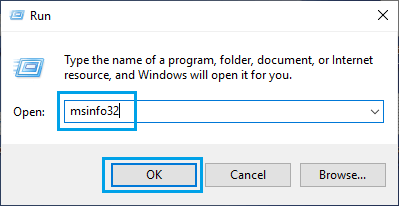
1. Press Windows + R keys > Type msinfo32.exe and click on OK.
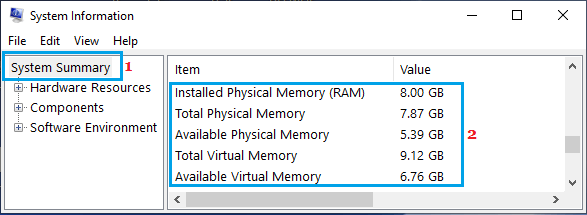
2. On System Information screen, scroll down in the right-pane, till you can see information about the Size of RAM installed on your computer.
3. Check RAM Size, Speed & Type Using Task Manager
The Task Manager utility as available in Windows can provide detailed information about the Size, Speed and Type of RAM installed on your computer.
1. Right-click on the Taskbar and select Task Manager.
2. On the next screen, go to Performance tab, select Memory in the left pane. In the right-pane, you will be able to see the Size, Speed and Type of RAM installed on the computer.
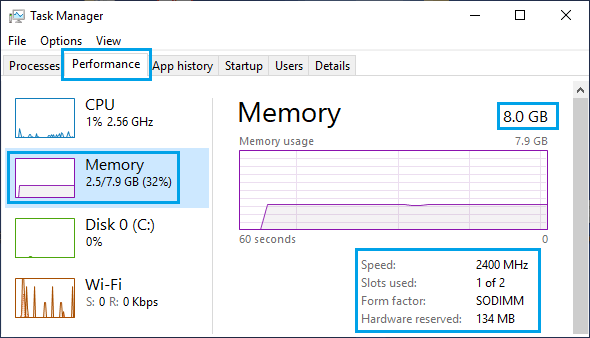
On the same screen, you can see information about the type of RAM, number of RAM slots taken and available for use on the computer.
Types of RAM Used in Computers
DRAM (Dynamic Random Access Memory) and SRAM (Static Random Access Memory) are the two main types of RAM available in the market.
Although SRAM is faster compared to DRAM, it is more expensive, uses more power and is available in less storage capacity.
Hence, DRAM or its faster versions like SDRAM (synchronous DRAM), DDR SDRAM (Double-Data-Rate SDRAM) are used in personal computers.
RAM Form Factor
When you check information about RAM installed on a Windows computer, you are likely to see the RAM Form Factor being mentioned as DIMM (Dual Inline Memory Module) and SODIMM (Small Outline DIMM).
DIMMs are twice as big as SODIMMs and these are in desktop computers and servers, while the smaller size SODIMMs are used in Laptop computers.