When a new computer is unboxed, powered-on and connected to a network (usually Wi-Fi) for the first time, Windows automatically assigns a Public profile for the network; which effectively results in your Home/Office Wi-Fi Network being setup as a Public network.
This has left many users wondering as to why their home/office network has been setup as a Public Network and not as a Private Network; which going by the term “Private” should provide more security; compared to an open-for-all sounding “Public” network.
Hence, let us go ahead and clear the confusion by understanding the difference between a Pubic & Private Network on a Windows computer and whether or not you should be changing your Home Wi-Fi network from Public to Private Network.
Related: How to Find Your Public & Private IP Address.
How Public & Private Networks Get Assigned in Windows
As mentioned above, the very first network that your computer connects to; is automatically configured as a Public Network by Windows and it is only when you try to connect the computer to a New Network (thereafter); that Windows comes up with “Do you want to allow your PC to be discoverable?” prompt.
If you select “Yes” the new network will be setup as a Private Network & if you select “No” the New Network will be setup as a Public Network.
Now that we understand how Public & Private Networks get assigned on a Windows computer, the next step would be to understand as to what exactly happens when a network is assigned a Public or Private profile on a Windows Computer.
Difference Between Public & Private Network in Windows
When any network is assigned a Public profile on a Windows computer, it is automatically treated as an unknown network by Windows; which triggers stricter security protocols and makes the computer hidden or invisible to all other computers and devices on that particular network.
Hence, whenever you connect the computer to a public Wi-Fi network at an Airport, Hotel, Library or Coffee shop; you should always connect using a Public network profile by selecting the “No” option; when Windows comes up with “Do you want to allow your PC to be discoverable?” prompt.
As far as the Home Wi-Fi network is concerned, you can continue using it as a Public Network (as it was initially setup by Windows). However, this prevents you from using networking features like File & Printer sharing; which are automatically disabled by Windows on a Public network due to security reasons.
If the nature of work requires you to Share Files with others on the network and you are facing problems connecting to a wireless printer; your computer needs to be made visible to other devices on the network and this can be easily done by changing the network profile of your Home Wi-Fi network from Public Network to Private network.
How to Switch From Pubic to Private Network
At any time, you can switch your Home/Office Wi-Fi network from Public to Private network by using the following steps.
1. Press Windows + I keys to open Settings.
2. On the Settings screen, select Network & Internet in the left-pane and click on Properties tab for the active network on your computer.
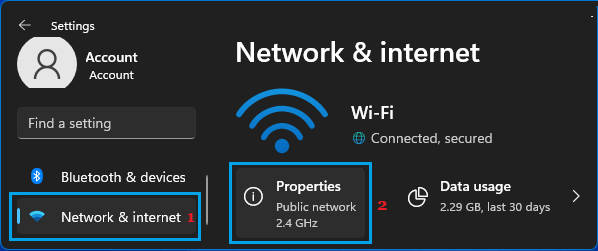
Note: If it is another network, click on Wi-Fi > select your Network on the next screen.
3. On the next screen, select Private Network to switch your Home Wi-Fi or the selected Network from Public to Private Network.
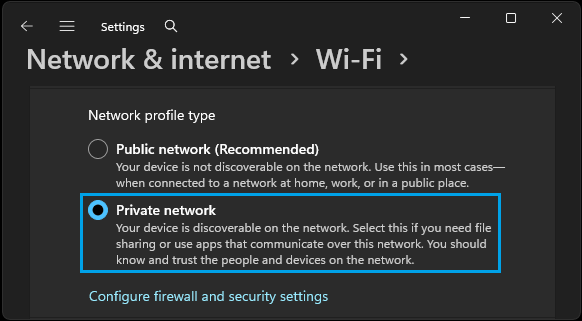
4. If prompted, enter the Admin Password to authorize this change on your computer.
Does Private Network Make Your Wi-Fi Network Less Secure?
Since, Public network profile is actually shown as being the “Recommended” network type on a Windows computer, it often leaves users wondering whether they have made their computer less secure by switching the Home Wi-Fi network from Public Network (Recommended) to Private Network.
However, this is not the case; considering the fact that switching from Public to Private Network is necessary for sharing Files/Printers on the network and this does not necessarily make the Home Wi-Fi network less secure, unless you are using an easy to guess network password and the Router is not using the latest available security protocol (WPA2 or WPA3).
- Private Network: When you switch your Wi-Fi network from Public to Private; Windows makes the computer visible to other devices on the network and allows it to communicate with printers, smart TVs and other gadgets; that are connected and visible on the same network.
- Windows Firewall: The firewall rules are relaxed locally and only for other devices/gadgets that are located on the same network. Windows Firewall continues to protect the computer from outside threats coming from the internet.
- Secure the Printer: Since, the computer is protected by Windows Firewall and Local network by a strong password, the only remaining gap is devices on the network that are still using a default password. You can close this gap by logging into the Admin Page of the device (say Printer by using its IP Address) and changing the Admin Password.
Hope, this has helped in clearing the mystery and confusion that surrounds the concept of a Public & Private Network on a Windows computer.