If the User Profile of any User Account on a Windows computer gets corrupted, the system won’t be able to read files, settings and configurations associated with that particular User Account; which can result in the following signs and error messages.
- Temporary Profile: Upon login, Windows may display “You have been signed in with a temporary profile” or “We can’t sign-in to your account” message.
- Login Failure: Windows may totally prevent you from logging into the User Account by displaying “User Profile Service failed the sign-in” error message at the login screen.
- Generic Profile: Windows may load a generic user profile; with empty Desktop, Documents and Photos Folder.
This can happen due to various reasons, including; temporary glitches (which usually gets fixed), deletion of critical data files, file synchronization errors and hardware failure.
Fix Corrupt User Profile in Windows 11/10
In our case, it was possible to actually fix the Corrupted User and gain access to all the files located in the User Account by using the Registry method as provided below in this guide.
If this does not work, you move to the second method; which requires you to create a new User Account and transfer files from the Corrupted User Account to New User Account.
1. Fix Corrupt User Profile Using Registry Editor
Login to the Admin Account on your computer and follow the steps below to identify and fix the Corrupted User profile on your computer.
1. Press Windows + R keys to open the Run Command on your computer.
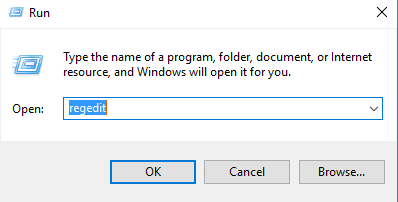
2. In the Run Command window, type regedit and click on OK.
3. On the Registry Editor screen, navigate to HKEY_LOCAL_MACHINE\SOFTWARE\Microsoft\Windows NT\CurrentVersion\ProfileList.
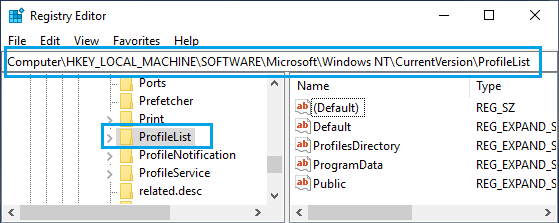
4. Open ProfileList Folder and you will see Folders starting with S-1-5. Each of these Folders represents a User Profile linked to a User Account that was created on your computer.
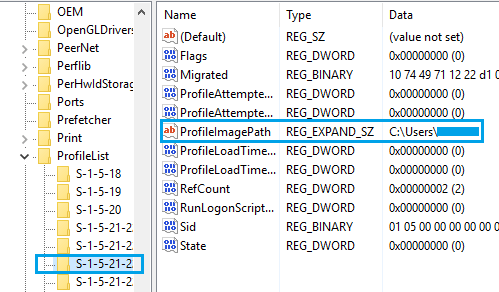
Now, the difficult task is to identify the right S-1-5 Folder that belongs to the corrupted User Profile. You can do this by clicking on each S-1-5 Entry and taking a look at ProfileImagePath in the “Data” Column.
As you can see in above image, the User Name (C:\Users\User Name) is clearly visible in ProfileImagePath Entry for the selected S-1-5 entry in the ProfileList Folder.
5. Select the right S-1-5 Folder in the left-pane and double-click on the State Field in the right-pane.
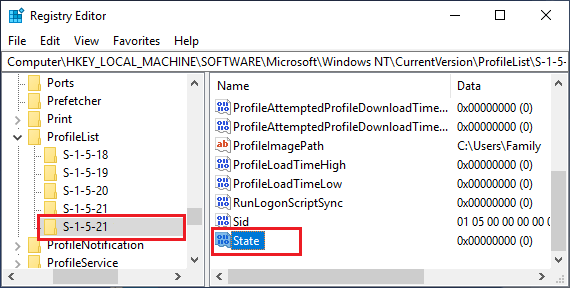
6. On “Edit DWORD” pop-up, change the Value Data from 1 to 0 and click on the OK button.
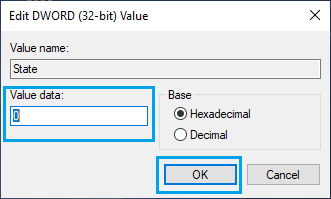
7. After this, double-click on RefCount entry and change the Value Data from 1 to 0.
Note: If you cannot find “RefCount”, right-click in any blank space in the right pane > click on New > DWORD (32 bit) Value and type RefCount as the Name for this New DWORD.
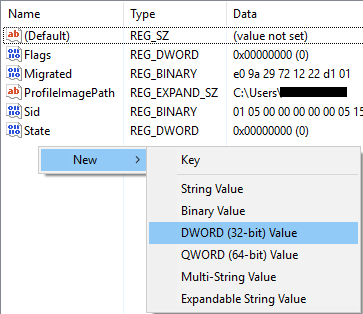
8. Double-click on the newly created RefCount DWORD and set its Value Data to 0.
After this, you should be able to login to the User Account which had a corrupted User Profile and gain access to all your files.
2. Create New User Account & Transfer Files
In this method, the first step is to create a New User Account by using steps as provided in this guide: How to Create Local User Account in Windows 11/10.
Once the new User Account is created, you can transfer files from the corrupted User Account to New User Account by using steps as provided in this guide: How to Copy Files From One User to Another in Windows.
Important: The Name of the New User Account needs to be different from that of the corrupted User Account.
What to Do If the Admin Account is Corrupted?
If the Admin account is corrupted, you can activate or enable the Hidden Admin Account that Microsoft makes available on Windows computers for such rare occasions. After logging in to the hidden Admin Account, you can try to repair the corrupted user profile by using the Registry Method as provided above in this guide.
If this does not help, you can create a new User Account and transfer files from the corrupted User Account to new User account by using the second method (above).