Running Task Manager as Admin provides access to system wide processes and allows you to perform advanced tasks, which can only be executed with administrative rights or privileges.
The good news is that you can Run Task Manager as Admin from within a Non-Admin Account, without the need to logout from the non-admin account and login to an Admin Account.
Run Task Manager as Admin
In general, running the Task Manager app or utility as Admin can provide you with the following benefits, which are not available when you Run Task Manager as a regular user.
- View all startup apps, programs and processes running on the computer.
- Stop, resume and restart any process running on the computer, regardless of whether the process is owned by another user or it is a protected process.
- Allows you to make changes to system processes and Run tasks requiring Admin rights.
Now, that we understand the benefits of opening Task Manager as Admin, we can go ahead and take a look at different methods to open Task Manager as Admin.
1. Run Task Manager as Admin Using Windows Search
An easy and direct way to access the Task Manager Utility with Admin privileges on a Windows computer is by using Windows Search.
1. Type Task Manager in the Search box > Right-click on Task Manager in the search results and select Run as administrator option.
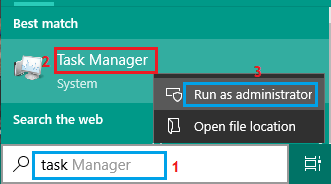
2. On the next screen, enter the password for your Admin Account to access Task Manager as Admin.
On the Task Manager screen, you will be able to view all the processes running on the computer and execute all available tasks, including those requiring Admin rights.
2. Run Task Manager as Admin Using Run Command
You can Run Task Manager as Admin from within any non-admin account on a Windows computer by using Run Command.
1. Right-click on Start button and click on Run.
2. In the Run command window, type taskmgr and press CTRL + SHIFT + Enter keys.
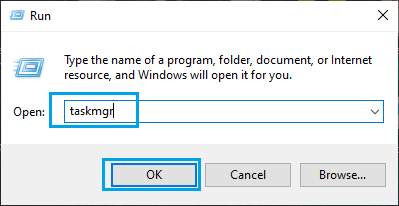
3. On the pop-up, enter the Admin Password and press the Enter key to gain access to Task Manager as an Administrator.
3. Run Task Manager As Admin Using Command Prompt
When you open Command Prompt as Admin, it allows you to open Task Manager with Administrative rights.
1. Right-click on Start button and click on Command Prompt (Admin).
2. On the Command Prompt screen, type taskmgr and press the Enter key.
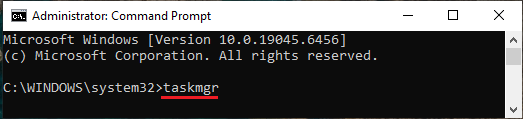
This will immediately take you to the Task Manager screen, where you will be able to execute tasks, which require administrative rights.
Note: There are multiple other ways to open Command Prompt As Admin.
4. Run Task Manager as Admin Using Shortcut
You can make it convenient for you to open Task Manager as Admin by creating a dedicated shortcut and placing it on the desktop of your computer.
1. Right-click on the Desktop (empty space) and select New > Shortcut.
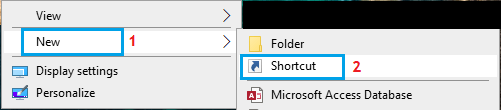
2. On Create Shortcut screen, type taskmgr and click on Next.
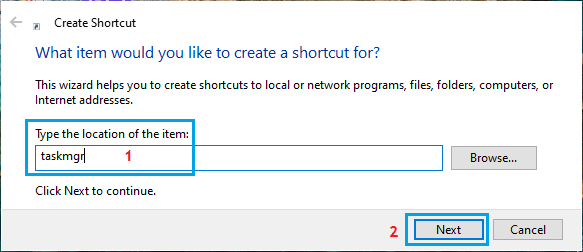
3. On the next screen, you can use the suggested name (Taskmgr.exe) or change it to Task Manager and click on Finish.
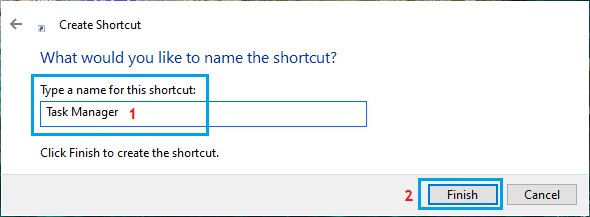
4. Once the Shortcut appears on the desktop, right-click on the Task Manager Shortcut and click on Properties.
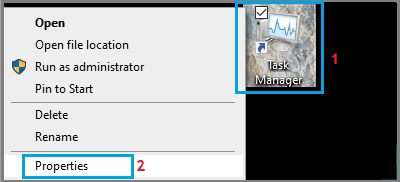
5. On Task Manager Properties screen, click on the Advanced Tab.
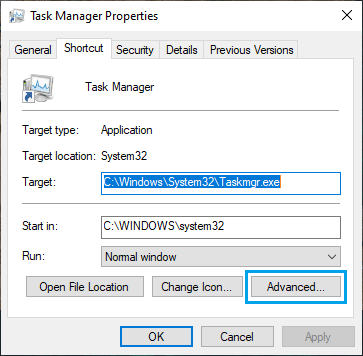
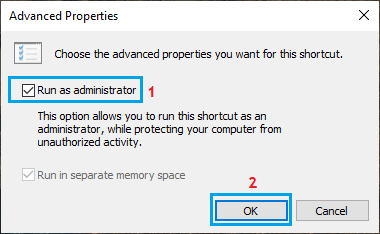
6. On Advanced Properties screen, check or select Run as Administrator option and click on OK.
7. On the next screen, authorize this change by entering the Admin Password.
After this, you will be able to Run Task Manager as Admin by just clicking on the Task Manager Shortcut.